Article
Issue #176 | AI-Generated Ads: Right vs. Wrong

A few months back, in The AI Regulation Wars Begin, I walked through the legal minefield forming around AI-generated creative: the New York synthetic-performer law, how the penalty/compliance structure created massive liability for any advertiser serving ads in the State of New York and the 15+ states considering similar-ish legislation.
That issue was about what’s happening, what you’re not allowed to do and the (very real, very high) cost of getting it wrong.
This issue is about the more difficult – but, arguably, more important – question: of all the things you are technically allowed to do, which ones should you do? Where’s the line between AI that’s good to go, AI that’s clever/productive/economical and AI usage that (likely) isn’t worth the risk/cost?
Before we start, the bad news: if you were hoping the legislators/regulators would eventually settle this for you, consider this: in the 3 months since that issue, they’ve somehow managed to make the answer less clear. The odds of any of us getting a crystal-clear rule are declining, not increasing.
Let’s Talk About NY State
When I wrote Issue #161, June 9 was 72 days away – but as I write this, the deadline has come and gone. New York’s synthetic-performer law is live. Everything I warned about is operative – each and every undisclosed synthetic performer serving impressions in New York is accruing liability with a 3-year statute of limitations. It doesn’t matter that (at least, to my knowledge) no penalty notices have surfaced yet. The State does not have to notify any brand in violation on June 10 for ~35 more months. They are in no hurry. The public ad libraries aren’t going anywhere (and even if they were, the AG has subpoena power).
In the interim, the Federal Cavalry – aka the DOJ task force – is still busy challenging state laws (with little-to-no results to share thus far, though that’s primarily a product of the federal court system, not their competence/lack thereof). One other bit of good news arrived on July 1, when the FTC proposed a policy statement arguing that some state AI rules are federally preempted. The key word is proposed: the public comment period doesn’t close until July 31, 2026. A formal policy statement wouldn’t go into effect for – at least – 1-2 months after that. In the most charitable reading, this development is a hopeful sign on the horizon.
While DC/the Trump Admin fights the states over AI rules, the FTC’s own substantive posture on AI deception has been loosening. Way back in 2024 (yes, I know it feels like a decade ago), the Commission went after a company called Rytr, an AI writing tool with the capability (among other things) to generate synthetic customer reviews on demand. It banned the review-generation feature outright. Since that ruling, it has been the FTC’s marquee “we’re serious about AI deception” proof point. That was, until December 22, 2025, when the FTC set the order aside in a highly irregular “reopen and set aside” process. The FTC’s Director of the Bureau of Consumer Protection’s comments that accompanied the move were incredibly informative: “Condemning a technology or service simply because it potentially could be used in a problematic manner is inconsistent with the law and ordered liberty.” The upshot of this is that the US Federal Government seems keen on (1) not unduly burdening the AI industry during this inflection point and (2) punishing bad conduct/actors, not the underlying tools, even in cases where it’s difficult to see how the tool didn’t facilitate consumer harm (i.e. creating fake reviews is unlikely to be a net positive for consumers, regardless of the circumstances).
It’s difficult to not look at those data points above and think, “Where in the world is the line?” – because I sure don’t know. On one hand, we have ~16 states that have passed or are in the process of passing laws that restrict the use of AI in communications or advertising-related situations; on the other, we have a federal administration that seems hell-bent on deregulating the AI sector as much as possible, to the point where they’re willing to deep-six their own landmark case. And caught in the middle are all of us – advertisers, brands, marketers, developers – who have no idea where the green/red lines are, what we can/can’t do, how much liability (if any) we’re accruing and/or when we’ll know more.
So, what do we do? Where do we go from here? Those are the questions I’ve been thinking more about – and I have some ideas.
Let’s begin with the principle that has not changed: deception is illegal. That was true before AI existed. It was true before the internet. It was true before the telephone. It is a bedrock principle of civilization, going back to Biblical times. The tools used to deceive and the manners by which those tools are employed for that purpose have certainly changed, but the bedrock principle remains true. The best evidence for that is the FTC’s own statements surrounding the Rytr reopen-and-set-aside order: the agency simultaneously sent warning letters reinforcing that publishing fake reviews is still illegal under the Consumer Review Rule.
If we build from that bedrock principle, 3 things stay on the wrong side of any red/green line no matter what disclosure you put on them:
- Fake reviews and testimonials: an AI that mass-produces “customer” reviews for products nobody used is polluting the marketplace with deception. The fact that a model wrote them is irrelevant.
- Synthetic personas presented as real customers: a generated UGC creator gushing about a serum they’ve never used (you know, because they don’t have skin) is deceptive. You cannot have an opinion about a product you never tried if you don’t exist.
- AI-generated before/afters or demos showing results the product can’t deliver: that isn’t “creative,” it’s a fabricated performance claim, governed by the same rule that’s governed weight-loss ads for 50 years.
None of these become acceptable with a label, because the disclosure isn’t the problem – the underlying deception is.
Now the other side – where do I think (note: this isn’t legal or compliance advice, I’m not a lawyer, do your own research/homework, your mileage may vary, etc.) AI use is acceptable (and even good)? I have a few ideas, divided into two categories. Category #1 is “what you show consumers”; Category #2 is “how you create what you show”:
Category #1 (“What Your Audience Sees”):
- AI-generated content is great when it enhances something true, or when it’s an obvious creative play that no reasonable person would mistake for reality. Think: a surreal, fantastical product visual, the soda can the size of a building, a car driving through a watercolor sky: nobody thinks that’s a documentary.
- Language translations leveraging AI to make an ad more accessible to specific audience segments (i.e. translating a true, correct, factually-accurate ad into Spanish, so that the Latino population in San Antonio can use your product/service). I’d argue this is one of the most substantial net-goods of AI, because so many SMBs we work with don’t have a reliable, cost-effective mechanism to translate their content into different languages.
- AI b-roll, background plates and motion graphics that make a real video better without faking the substance of a claim. Once again, this just saves boatloads of money for SMBs – a day of b-roll filming can easily cost $5,000-$10,000 (depending on location), plus require permitting (esp. If you’re using drone footage or flyovers). For a brand in the NE US that gets 4 “real” seasons, having appropriate b-roll can easily be a $20k+ expense each year.
- Genuine whimsy, where the fakeness is the point and is entertaining.
Category #2 (“How You Work”):
- Concepting, storyboarding, variant generation, the unglamorous 90% of production where AI is a force multiplier and the consumer never sees the raw output anyway.
- Script timing is one of my favorite use cases. Instead of hoping that your team can time your script, have AI “read” them to ensure they’ll fit into the space we’ve allocated.
- Concept Resonance is another “background” task that can be fantastic – give AI the script/ad content you want to run AND the details on the target audience, have it generate a synthetic test audience and evaluate the efficacy of the ad. You might find (as we do more often than we’d like to admit) that the ad we marketers think is clever, memorable and guaranteed-to-work doesn’t score that well with the AI audience. In those cases, you can either (a) move to testing it with real people or (b) create a variant that addresses the “concerns” flagged by the AI.
From those examples, two concrete conclusions arrive: (1) the dividing line is intent and effect and (2) internal AI use is essentially unbounded – the line only exists where output reaches a consumer. Generating a fake review that a real person reads is still a fake review, no matter what tool made it.
The big question: are you using AI to delight or to deceive? Are you using it to enhance a true story, or to manufacture a false one?
If you use it to make a real thing more compelling or more economical for the business? Great! If you use AI to make a fake thing (review, testimonial, person) look real, that’s where you get yourself/your brand/your client into potential hot water.
Obviously the lines around where those specific things happen are still – very much – in dispute. But the spirit of the law seems to be consolidating around that principle (albeit through some ham-fisted mechanisms, as is the case with the NY law and the pending Massachusetts law).
To help our team as we figure out where to go, we’ve created a 3×3 “Moral Alignment” matrix (if you’ve played D&D, or watched Stranger Things, this probably looks pretty familiar), with adherence to laws/rules on the x-axis and the moral alignment on the y-axis. We’ve also put in an example of an action/behavior that would fall in each one.
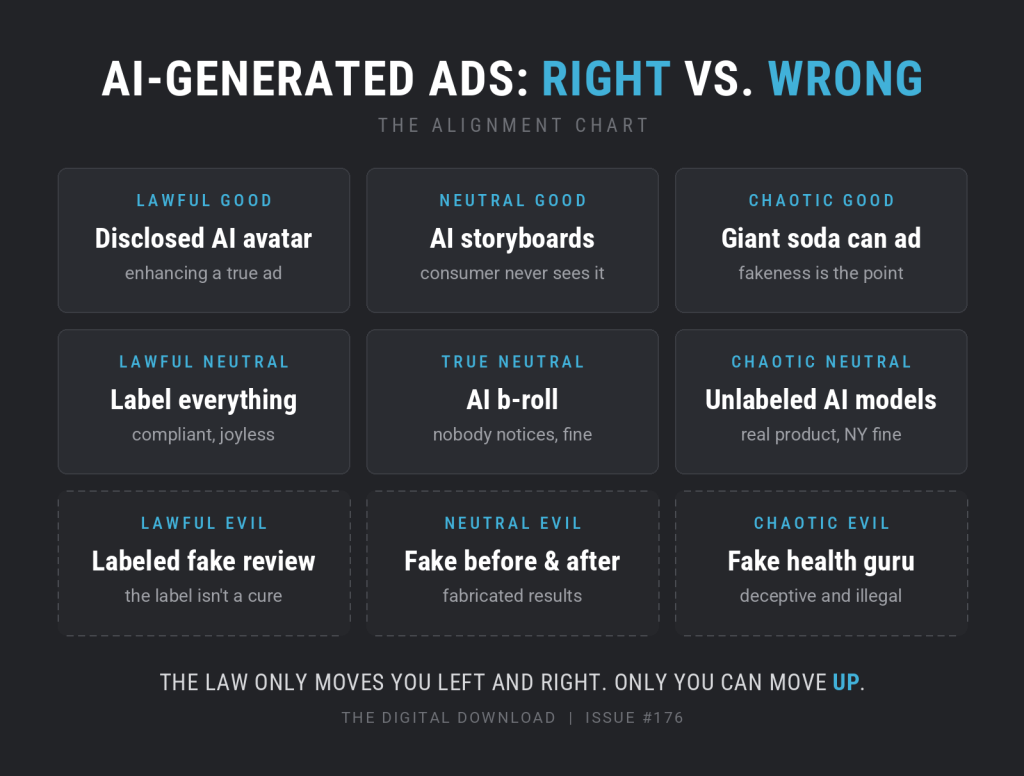
If the chart makes you argue with a square (or 2), good. That’s the point. This isn’t intended as a compliance document; it’s a forcing function designed to make you say out loud which axis you’re optimizing for.
What I’ve found interesting – especially as we’ve begun dealing with the fallout from these laws/regulations – is that the law only moves you left/right on this chart. It’s up to you (!!!) to decide how high up (or down low) you sit. You can comply with the letter of the law while violating the spirit of it.
That brings me to the final – and most important – point:
Make It About Trust, Not Compliance
I’m not going to pretend these AI laws are smart, good or easy to deal with; honestly, I think they’re about as intelligent as using a chain saw for open-heart surgery. But that and $0.99 will get you a cup of coffee at Wawa.
But sometimes idiotic rules can reveal a deeper truth – and I think that’s the case here, and it’s the thread that weaves through this entire article. I don’t view all of these laws as a compliance checklist; I view them as a crude, primitive mechanism to preserve trust between brands + consumers.
And when you stop looking at all of this through the lens of a regulator or compliance officer, you see that we’re all trying to do the same thing: build and preserve trust with an audience. So, instead of solving for a random legal checklist, solve for that – and you’ll probably end up in the same place, anyway.
The advantage of doing that in high-trust categories (i.e., health and wellness, financial services, supplements, anything where the consumer is putting a substance in their body or their money on the line) is obvious: synthetic content doesn’t just risk a fine. It detonates credibility. The moment a consumer realizes that your “customer” is a fake AI-powered rendering or your “results” are completely fabricated, every other claim you’ve ever made (whether true or false) is presumed fake, too. That was true before AI (see Theranos, Volkswagen, Madoff) even existed.
If you read The Aggregation Function Problem, you already know why this is so dangerous: brand trust is a multiplicative system. It’s built in drops and lost in buckets. 1,000 consistent, honest moments are little drops, slowly filling up the trust bucket; 1 “their testimonials are fake” moment dumps those years (maybe decades) of goodwill and trust on the ground.
But this isn’t limited to those high-trust/high-impact categories. In fact, we’re watching it play out in CPG. The entire space is flooded with AI-generated product shots (some that are downright deceiving), synthetic testimonials and too-perfect demos. But we’re also seeing that consumers are getting very good at spotting them. Every obviously-AI ad is a mini tragedy of the commons, taxing every “good” actor in the space as customers reflexively begin distrusting everyone.
And therein lies the real opportunity: when generated content becomes infinite and free, the value of being demonstrably, verifiably real goes through the roof. When everyone can fake it, the brand that visibly doesn’t own something nobody can generate: Authenticity. Truth. Trust. Realness.
That’s the same drum I keep banging, just pointed at a new target: when the cost of production falls to zero, the premium on trust goes to infinity.
So, instead of asking, “is this compliant” – the better question to ask is, “would this build or undermine the trust we’ve already built with our audience, if they found out we used AI to make it?” Only if it passes THAT test do you move on to the, “What (if anything) do we have to do to ensure this is legally compliant?”
Put another way, the trust test resolves the moral question; it does not resolve the legal compliance question. A truthful ad with a synthetic performer is morally fine and legally radioactive, which is why you disclose that it has an AI performer. Not only is that the legally-mandated thing to do, but it’s also the right thing to do by your customers (and – oddly enough – is more likely to build trust over time than erode it).
The Takeaway
So, should you use AI-generated ads? Yes. Enthusiastically, where it enhances something true or delights without deceiving. And never, no matter how permissive or chaotic the enforcement climate gets, where it creates a false impression a customer would act on, especially in the categories where that customer is trusting you with their health or their money.
The Trump Administration, The States and the Courts are engaged in a democratically-sanctioned variant of trench warfare over where the legal line sits – but, I’d argue, the end result is less important than it seems.
So, don’t mistake the dust cloud around that battle for permission to do whatever until you’ve been told (or sued). Until there’s real clarity, doing the sketchy version of any of this is categorically insane. The smart marketers/brands aren’t asking “can we get away with it?” (the honest answer is probably, but at what cost); they’re asking, “Would we be comfortable if the customer knew exactly how this was made?”
If the honest answer is no, you already have your answer.
The brands that win the next few years won’t be the ones who generated the most. They’ll be the ones their customers still believe.
Cheers,
Sam