Article
Issue #194 | The Last Minute BFCM Playbook
I spent most of the last week in Lithuania (it was both incredibly cool and quite cold) speaking at an eCommerce conference – with BFCM of the main topics of discussion. Most EU brands simply have no frame of reference for (a) the scale of BFCM and (b) why in the world so many US brands offer such insane discounts during those few days.
Honestly, I don’t, either.
But Black Friday is ~13 days away, which means the offer/discount/special you’re going to run has (almost certainly) already been decided. Adobe’s Shopping Trends has the average online discount climbing from 14% in early November to 21% the week before Thanksgiving, then to 30% once Cyber Week starts. Salesforce has a less festive number: global digital traffic grew 18% in Q2, while order volume grew 1%.
Put another way: more shoppers are showing up, barely more of them are buying and nearly every brand is resorting to price margin chopping to win them over.
Last November, I wrote a long (even by my standards) last-minute BFCM playbook – and, after reading it again, I still agree with almost all of it. What almost nobody does is the math on what a given discount does to the rest of your P&L.
You can build + run the model in an hour or 2 with AI – and you still have ~13 days (including today) – so what are you waiting for?
What The Discount Actually Costs
Let’s begin with the most common BFCM offer – the discount – which is the first decision most brands make. The two most common ways it’s decided: (1) whatever you did last year or (2) whatever competitors did last year, plus a little bit to make it better/more attractive/more compelling. Neither of those makes any sense as a justification, but that’s another conversation for another day.
At its most fundamental level, contribution per order is the price the customer pays (itself your standard price less the discount you chose), less your costs of goods sold, less everything it costs to get that order out the door (pick + pack, payment processing, shipping, allowance for returns, customer service, etc). A discount comes entirely out of the first term; nothing else gets any cheaper.
Mathematically, if your gross margin is m and you reduce it by a discount (d), contribution per unit falls from m to (m − d). To earn the same contribution you’d have earned at full price, you need to sell m ÷ (m − d) times as many units. Before fulfillment costs:

Now, add back the costs a discount doesn’t touch and you can mathematically determine exactly how bad this gets for the underlying business (not the Shopify dashboard – that’s going to look spectacular this holiday season):
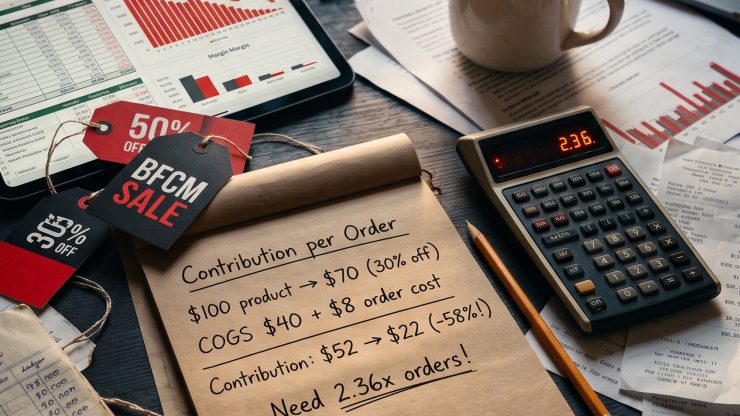
Imagine you have a $100 product at 60% gross margin, with $8 in per-order costs. At full price, contribution per order = $52. But, let’s imagine you run a 30% off discount during BFCM, so your BFCM buyer pays $70. Well, your product still costs $40, the order still costs $8 to get out the door, so contribution per order = $22. In this scenario, revenue per order fell 30%, while contribution per order dropped 58%. End result? You need 2.36x the number of orders just to create the same contribution per order. If you get even more aggressive and make shipping free on an order that normally carries a $7 charge, contribution drops to $15. In that scenario, you now need 3.47 orders just to generate the $52 in contribution you make on a single full-price order.
The most common response to this is something along the lines of – “BFCM buyers aren’t the people who would have bought at full price.”
That’s valid. Some aren’t. Maybe even the majority aren’t.
But some are. Every one of them is a customer who would have paid you $100 and is now only forking over $70 for the exact same product. And making matters worse: those 4+ days of BFCM also pull full-price demand forward out of December, which most eComm brands conveniently forget (there’s a reason the first week-ish of December is always soft).
Now, none of this registers in most ad accounts, because Meta/Google/TikTok report (by default) on revenue/conversion value, not contribution per order.
Fortunately, you can calculate exactly how much your discount impacts your ad account targets with some simple math. If ROAS = revenue / cost, then break-even ROAS = price / contribution. On the full-price order from our example above:
Break Even ROAS = $100 ÷ $52 = 1.92
On the 30%-off order, Break Even ROAS = $70 ÷ $22 = 3.18
If you do the free shipping, Break Even ROAS = $70 ÷ $15 = 4.67
In all 3 of these scenarios, this is the same product, with the same costs, presumably running some of the same angles/messaging. The only thing that changed was the discount – but when it did, the ROAS required to break even increased 66% (143% with free shipping).
If you’re running media for this brand and you maintain the 2.5 ROAS target that was comfortably profitable in September/October, you’re now (more than likely) losing money on every single order that comes through during BFCM.
This is The Ratio Trap at its most acute: a target that continues to look perfectly reasonable long after the economics underneath it have collapsed faster than Lehman Brothers.
If that wasn’t bad enough, everything above assumes the market stays flat while your discount is live. Unfortunately, we have reams of data that conclusively demonstrates that’s not a valid assumption during BFCM.
Let’s assume your October CPA on this product was $30. CPMs double during BFCM (which is ordinary). If the share of impressions that convert stays flat, CPA becomes $60 – against $22 of contribution. Impressions now have to convert at a 2.73x higher rate just to maintain your previous CPA (which, by the way, is LOSING MONEY).
Fortunately, in a well-run account, they often do. Last year, I described BFCM media buying as paying 5x more for an impression that’s worth 7x more. That’s still valid. It does vary by hour, by offer and by product (there are some products that are just BFCM losers and no matter how attractive you make the deal, they’re not converting 2.73x better). What you SHOULD do is marry the two sections of this newsletter together in your BFCM modeling: (1) how many more units you need to sell to offset your discount/offer AND (2) how much more efficiently you need to sell them in order to overcome the more competitive auction environment that is BFCM.
Once you do that, measure it in orders per 1,000 impressions, not session conversion rate. Roughly ~20% of holiday eComm traffic will be from AI agents (scrapers included), which means your session counts are about to get a lot noisier. Normalizing on 1,000 impressions should reduce some of that noise AND give you more confidence about the overall performance of your site + your media.
BFCM Buyers Aren’t Standard Buyers
The standard defense of buying a discounted customer is that a healthy portion of them come back in the subsequent months and buy at full price. As someone who runs an agency and buys LOTS of media, I’d love to tell you that’s true, but the reality is that it often isn’t.
Fortunately, last year’s BFCM buyers have now had 12 months to come back – so you can figure out exactly how many of them did come back and what those customers were worth – then factor that into any of your forward-looking customer value models.
Doing this is trivially easy for most brands (especially if you’re on Shopify). Pull 2 cohorts from your order export: everyone whose first order came during your BFCM 2025 sale period (the actual days the deal was live, not just BFCM), and everyone whose first order came at full price in September/October 2025. For each, calculate the share who bought again within 12 months and the average contribution on those repeat orders. Break-even CPA then becomes first-order contribution + (repurchase rate × repeat contribution).
Say full-price first-time buyers repurchased at 30%, BFCM first-time buyers at 15%, and a repeat order carries $50 of contribution. The full-price customer is worth $52 + (0.30 × $50) = $67. The BFCM customer is worth $22 + (0.15 × $50) = $29.50. Repeat behavior doesn’t close the gap; it actually widens it, from $30 to $37.50. While you’re exporting stuff, look at the most common SKUs for BFCM repurchasers. If the 2nd order also came during a promotion, make sure you value it at the discounted margin.
You might read this and think, “Our BFCM cohort repurchases just fine.” Great – then you’ve earned a higher break-even CPA, and you can bid more aggressively this year (or enjoy making more money). Either way, you’re setting the ceiling based on a real number, not one you’ve assumed or based on hopes, dreams and/or vibes.
And this all brings me to my plea (which I’ve made before): think about different offers during BFCM. I even wrote an entire newsletter about different kinds of BFCM offers that’ll make your CFO smile. Give it a read. Please.
The entire reason I wrote that article is simple: a percentage discount is the only offer that costs you exactly what the customer receives: every $1 off delivers $1 of value and costs $1 of margin. A gift with purchase delivers its retail value at its cost of goods. At 60% margin, a gift that retails for $30 costs you $12. Put it on the $100 order instead of the 30% discount, and contribution is $40 instead of $22.
You might read this and think, “Customers don’t value a free gift the way they value cash off” – and you’d be right. So assume they value it at half its retail price. $60 of retail product delivers the same $30 of perceived value, costs you $24, and still leaves $28 of contribution. If customers value a gift at more than (1 − m) of its retail price, the gift beats the discount. At 60% margin, that’s anything above $0.40 on the dollar.
Sell December During November
Then there’s the move I’ve almost never seen a brand try: using BFCM to promote what comes after it.
For the next 2 weeks, more people will look at most consumer brands than at any other point in the year….and most of them won’t buy. So, why not give them a reason to raise their hand anyway: a limited release, launching December 8 at full price, with a waitlist on every BFCM lander, on the order confirmation page + in the retargeting ads aimed at people who visited and didn’t buy.
It probably sounds crazy, but run the math: Imagine your brand generates 100,000 visitors during BFCM. 4% join the waitlist (4,000 people); 15% of those who joined buy at launch, all at full price. That’s 600 orders, each with $52 of contribution margin = $31,200 contribution margin. To earn the same at 30% off, you’d need 1,418 orders, each one obtained from media purchased at the highest CPM week of the year. The waitlist orders arrive by email, which costs next to nothing to send.
This actually undersells it, for 2 reasons: (1) a discount pulls full-price December demand into a discounted November; a drop does the reverse, converting November’s attention into December revenue at full price; (2) someone who signs up to pay full price for something they can’t have for 3 weeks has paid a real cost to signal interest (if you read last week’s issue, they’re very nearly a fit by definition). Their probability of buying again is significantly higher than the discount-driven buyer.
The best part is that this strategy does NOT pull attention away from the sale during the ~week that matters most, provided you keep it where the sale is already lost or already won: the non-buyer retargeting pool and the post-purchase page. The person who just bought at 30% off is the cheapest person you will ever sell a full-price product to 3 weeks later.
Now What?
1. Compute break-even ROAS for every hero SKU. Discounted price ÷ contribution after COGS, per-order costs + any shipping you’re discounting/absorbing. It’s almost certainly higher than the ROAS target running in your account right now. If you have the time, add a column into Meta Ads Manager + Google Ads so you can see it in real time.
2. Pull last year’s cohorts. BFCM 2025 first-time buyers vs. full-price first-time buyers – 12-month repurchase rate and repeat contribution for each. Use those numbers to update your priors on what a BFCM customer is worth long term. It might be better than you thought. It might be worse than you imagined. But either way, it’s better to know.
3. Put both numbers in the account. Cost caps at (or below) break-even CPA on every campaign pushing discounted SKUs. If you’re running value-based bidding, pass contribution back to the platform instead of revenue. Otherwise, the algorithm will chase the deepest-discounted baskets, simply because those convert best.
4. Rebuild part of the offer. Pull 5–10% out of the headline discount and put that value back as gifts, thresholds or bundles (aka anywhere customers value what they get at more than it costs you).
5. Put a December drop on the BFCM page. Promote the waitlist on the landers, the confirmation page + non-buyer retargeting. Launch at full price, to an audience that already asked for it.
The reality is that more brands go bust from success than failure. The easiest way to avoid it is to figure out what discounts really cost, what targets you need to hit and when to pass BEFORE the BFCM craziness begins.